Campervan Electrical Systems Explained (Complete Guide)
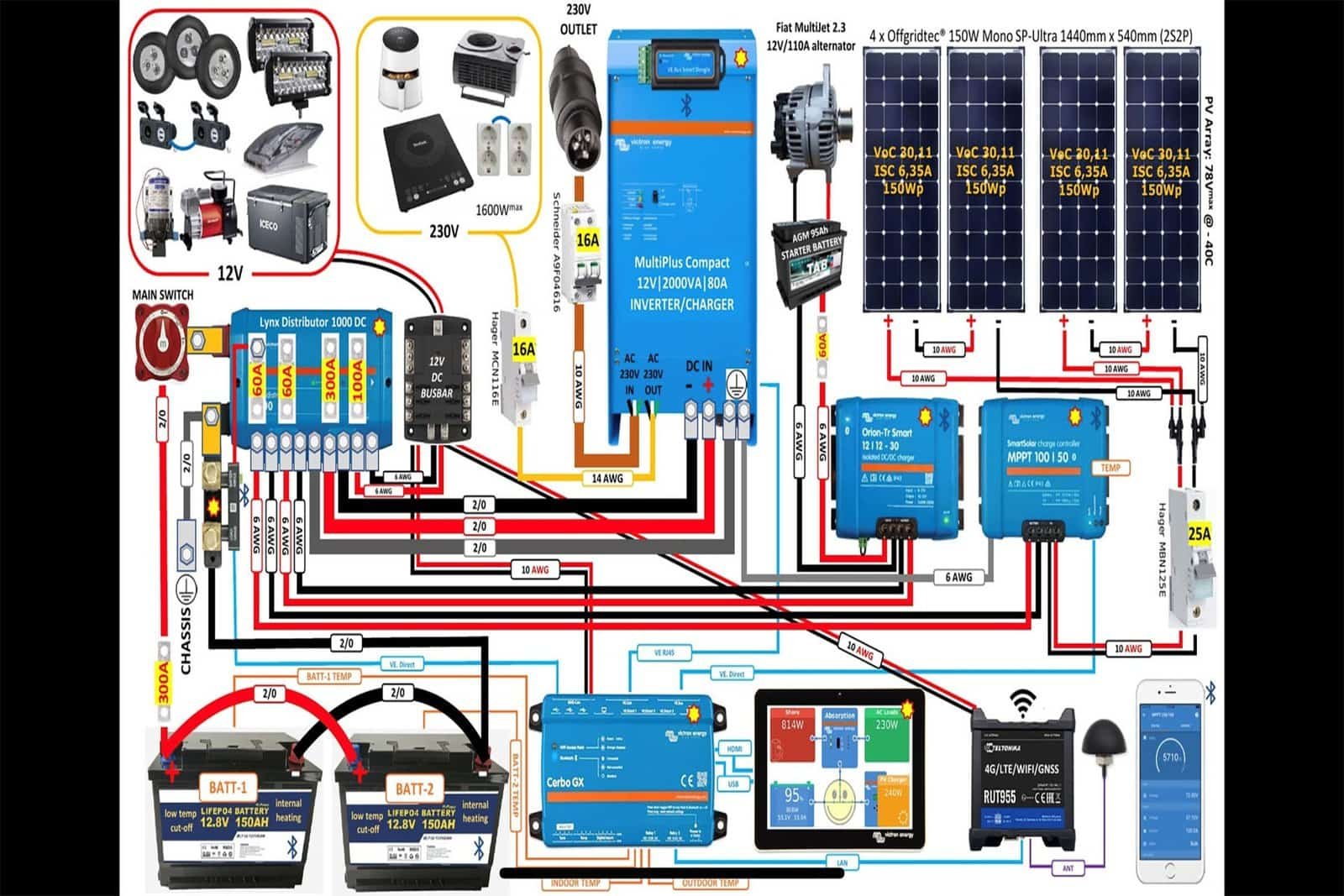
If you’re planning a campervan conversion, one of the biggest puzzles is the electrical system. It’s the part that makes your van feel less like a steel box on wheels and more like a proper home. Lights, refrigeration, charging your phone, or even running a laptop all depend on it. Without a reliable setup, you’ll either be frustrated or forever chasing hook-up points.
A campervan’s electrical system isn’t one-size-fits-all. The right setup depends on your travel style, budget, and appetite for independence. Weekend warriors can often get by with a simple 12v leisure battery and split charging, while full-timers usually need solar panels, inverters, and bigger battery banks. Understanding these differences from the start saves money and prevents costly rewiring down the road.
The basics come down to two types of power: 12v DC and 240v AC. Your van runs on 12v for things like lights, water pumps, and fans. If you want to power household appliances such as kettles or laptops, you’ll need 240v through an inverter or campsite hook-up. Balancing these two systems, and knowing when you actually need them, is the cornerstone of any conversion.
A surprising number of DIY builders underestimate how much energy they’ll use. Fridges, for example, can quietly drain a battery bank in days if it’s not sized correctly. Add in a few laptops, a heater fan, or Starlink internet, and suddenly your “basic setup” isn’t so basic anymore. Planning around your actual usage is far more important than copying someone else’s wiring diagram.
Of course, none of this matters if your system isn’t safe. Campervan electrics need proper fuses, breakers, and cable sizing to prevent overheating and fire hazards. The UK also has regulations for 240v installs, and insurance companies will expect compliance. A DIY system can be safe and legal, but it requires following best practices and sometimes getting professional certification for peace of mind.
This guide is designed to demystify campervan electrics. We’ll walk through 12v and 240v systems, batteries, inverters, split charging, and solar setups in detail. Expect practical advice, wiring examples, and clear explanations without the jargon. Whether you’re building a budget weekender or an off-grid powerhouse, you’ll come away with a clear plan and the confidence to power your adventures.
Along the way, we’ll link to in-depth guides like Installing a 12v & 240v Campervan System and Best Campervan Batteries & Inverter Setup. Think of this as your master handbook, branching off into specialist topics when you need the extra detail.
Understanding Campervan Electrical Basics
Before diving into wires and fuses, you need to get comfortable with a few fundamentals. Campervan electrical systems might sound daunting, but they’re essentially about controlling and distributing stored energy safely. Once you grasp the difference between 12v DC (direct current) and 240v AC (alternating current), most of the fog clears. Everything else builds on these two basic principles of how electricity works in a van.
12v DC is the heart of almost every campervan. Your leisure battery stores energy at 12 volts, and most vanlife gadgets - lights, fans, water pumps, and fridges - are designed to run off it. The advantage is efficiency and safety: low voltage means less risk of serious electric shock. However, 12v requires thicker cabling, and poor connections can cause overheating. That’s why choosing the right cable size matters from day one.
On the other hand, 240v AC is what you find at home in the UK. It’s needed for running household appliances like kettles, microwaves, and hair dryers. To get 240v in a van, you either plug into campsite hook-up points or use an inverter that converts 12v DC to 240v AC. This allows flexibility, but it comes with added complexity, higher costs, and stricter safety regulations.
One of the key terms you’ll see when researching electrics is wattage. Watts are simply volts multiplied by amps, and they tell you how much power something consumes. A 60-watt lightbulb running on 240v draws just 0.25 amps, but the same 60 watts at 12v needs 5 amps. That’s why current draw is so much higher in low-voltage systems, and why proper fuse ratings are crucial.
Think of amps as the volume of electricity flowing, volts as the pressure behind it, and watts as the total work being done. This simple analogy helps when you’re calculating your daily energy use. If you underestimate how many watts you’ll need to run appliances, you risk flat batteries and a very warm fridge full of spoiled food. Planning your electrical load is the first practical step.
It’s not just about running things - it’s about storage. Campervans use leisure batteries to hold energy, and you’ll constantly be balancing how much you consume against how much you recharge. Without enough recharging sources - like solar, split charging, or mains hook-up - you’ll quickly deplete your system. That’s why most complete builds incorporate more than one way to refill the batteries during travel or while parked up.
To keep everything safe, campervan systems use fuses and breakers. These components protect your cables and equipment from overheating if there’s a short circuit or overload. Skipping fuses is one of the most dangerous mistakes beginners make. A properly sized fuse should always be the weakest point in the chain, so if something goes wrong, it blows safely instead of melting wires behind your walls.
Another often-overlooked component is the bus bar. This is essentially a distribution block where multiple wires can connect neatly to a single battery terminal. Bus bars reduce clutter, make troubleshooting easier, and keep connections solid. In fact, messy wiring is a leading cause of system failures in DIY conversions. Investing in simple, organised components like bus bars and fuse panels pays off long-term.
Grounding is another critical part of electrics that often confuses people. In a campervan, the negative side of your 12v system should be bonded to the vehicle chassis. This not only completes the circuit but also improves safety by ensuring faults have a path to ground. For 240v systems, however, earthing must be handled differently and usually requires an RCD for protection.
The UK has stricter rules for mains power than many other countries. If you’re wiring 240v in your van, you’ll need to use a consumer unit, correct cable types, and proper connectors. A professional electrician should check your system before use, especially if you plan to insure your van. Skipping this step may save money initially, but it risks both your safety and your policy validity.
Most vanlifers rely heavily on 12v systems because they’re simpler and more efficient for off-grid use. For example, a 12v compressor fridge is far more power-efficient than trying to run a standard 240v household fridge through an inverter. Designing your setup around 12v appliances wherever possible reduces strain on your batteries and extends your off-grid independence between charges.
Still, some devices require 240v no matter what. Laptops, TVs, and high-power cooking appliances often need mains voltage. This is where inverters come in. Choosing the right inverter size and type is crucial, and we’ll explore this more in the section on batteries and inverters. For now, it’s enough to know that inverters convert stored 12v power into the 240v you’re used to at home.
If you’re worried this is all too technical, don’t be. The basics can be simplified into three questions: How much power do you need? How will you store it? And how will you recharge it? Once you answer those, the rest becomes a matter of choosing the right components. Later sections in this guide will help you calculate your energy use and build a system that fits.
There are fantastic tools available to help with planning. Online load calculators, wiring diagram templates, and even beginner-friendly YouTube tutorials can guide your design process. Just remember, copying someone else’s setup without adjusting for your lifestyle often leads to frustration. A digital nomad working remotely will need far more capacity than a weekend surfer running only a coolbox and a few LED lights.
At this stage, the goal isn’t to memorise electrical theory - it’s to get comfortable with the concepts. Voltage, current, and wattage will keep coming up throughout this guide, so keep that triangle in mind: Volts × Amps = Watts. With those basics in your toolkit, you’re ready to start planning your system. The next section covers exactly how to translate your needs into a working wiring diagram.
If you’d like a deeper breakdown of wiring setups, check out our dedicated guide on Installing a 12v & 240v Campervan System. It goes step-by-step with diagrams and safety checks, so you can follow along without second-guessing. For now, let’s move into the planning stage, where you’ll calculate daily consumption and map out the electrical backbone of your conversion.
Planning Your Electrical System (12v & 240v)
Planning your campervan’s electrical system is where theory turns into something practical. This stage sets the foundation for everything else - if you get it right, your system will run smoothly with minimal fuss. If you skip or rush it, you’ll constantly be firefighting problems. Think of it like designing the plumbing in a house: once the pipes are hidden, changes are costly and disruptive.
The first step is calculating your daily power consumption. This involves listing every electrical item you plan to use, from lights and fans to laptops and fridges. Write down how many watts each consumes and how many hours per day it’ll run. Multiplying the two gives you watt-hours. Add everything up, and you’ll have a ballpark figure of your daily energy needs in watt-hours.
Take a fridge as an example. A 12v compressor fridge might use 45 watts when running, and it cycles on and off throughout the day. Over 24 hours, it may consume around 500 - 600 watt-hours. Compare that with a set of LED lights drawing only 10 watts for three hours a night - just 30 watt-hours. This exercise makes it clear which items dominate your power budget.
Once you know your consumption, you can size your battery bank. Leisure batteries are rated in amp-hours (Ah). To convert watt-hours to amp-hours, divide by 12 (for a 12v system). So, if you use 1,200 watt-hours daily, that’s 100Ah per day. Most vanlifers aim for two to three days of autonomy, meaning a battery bank sized around 200 - 300Ah would be sensible for that lifestyle.
But batteries are only one side of the equation. You also need to think about how you’ll recharge them. The three main methods are split charging from your alternator, plugging into campsite hook-ups, or using solar panels. Each has strengths and weaknesses, and most vanlifers combine at least two to avoid being stranded with flat batteries. We’ll dig into these options in later sections.
Designing your wiring diagram is the next logical step. A wiring diagram maps how your system connects: batteries, bus bars, fuses, appliances, and recharging sources. Even a rough sketch on paper helps spot potential issues before you buy components. If you’re unsure, our Installing a 12v & 240v Campervan System guide offers step-by-step layouts to get you started with confidence.
For UK van conversions, it’s crucial to remember legal compliance. While 12v DC wiring is usually straightforward for DIYers, 240v AC systems fall under stricter rules. Using the correct cables, consumer units, and RCD protection is mandatory. Insurers may demand proof of safe installation, and a professional sign-off can prevent arguments if you ever need to make a claim.
Budget plays a massive role in planning. A bare-bones electrical system with a single 100Ah AGM battery and minimal wiring might cost under £500. A mid-range build with lithium batteries, solar, and an inverter can push £2,000 - £3,000. At the top end, full-timers investing in large lithium banks, Victron Energy inverters (see our top choice on Amazon below), and monitoring systems can easily spend £5,000+.
Your travel style is another factor. Weekend campers staying on campsites with hook-ups may only need a small battery and basic split charge. Full-time off-grid travellers need larger battery capacity, multiple recharging methods, and high-efficiency appliances. Identifying your lifestyle before buying parts avoids the trap of upgrading later - which usually costs far more than sizing correctly the first time.
Another planning tip is to allow room for expansion. Many vanlifers underestimate how their needs evolve. You may start with LED lights and a fridge but later add Starlink, an electric heater, or a blender. Oversizing cables, fuse boxes, and leaving space on bus bars future-proofs your system. Spending a little more upfront saves ripping out half your wiring later when you want more power.
Planning isn’t just about the “big” components. Small details matter too, like choosing the right cable size, fuse rating, and connectors. Undersized wiring can cause overheating and voltage drop, leaving appliances underpowered. A wiring calculator is your best friend here. If in doubt, always go thicker - oversized cables improve efficiency and safety, while undersized ones risk costly failures or even fire hazards.
When designing your 240v side, think about how many outlets you really need. Many people install far too many sockets, forgetting that every one adds complexity and potential weak points. A better approach is to plan strategically: a double socket in the kitchen area, another by the bed for laptops or chargers, and perhaps one more near a workspace if you work remotely.
Don’t forget about ventilation and placement of components. Batteries, inverters, and chargers generate heat and need airflow. Lithium batteries cope better than lead-acid in enclosed spaces, but they still shouldn’t be crammed into tight corners. Grouping components together - ideally under a bench seat or in a dedicated electrical cupboard - keeps wiring short and makes troubleshooting easier when something inevitably needs checking.
If this all feels overwhelming, remember that you don’t have to reinvent the wheel. Many vanlifers follow tried-and-tested setups that balance cost, reliability, and flexibility. Check our Best Campervan Batteries & Inverter Setup guide for examples. Seeing real-world systems, complete with component lists and wiring diagrams, makes planning less abstract and much more achievable.
For those chasing true off-grid independence, planning involves integrating solar from the start. Solar panels aren’t a bolt-on afterthought - they affect your roof layout, cable runs, and even how you orient the van when parked. Deciding on rigid or flexible panels, panel wattage, and charge controllers early ensures your system grows seamlessly rather than as a patchwork of mismatched upgrades.
Ultimately, planning is about aligning three things: your power needs, your budget, and your appetite for independence. Get that balance right, and the rest of your conversion falls into place. Cut corners here, and you’ll pay for it later in frustration, rewiring, and wasted money. Now that you’ve got a framework for planning, let’s dig into the details of actually installing your 12v system.
Installing a 12v Campervan System
The 12v system is the lifeblood of any campervan conversion. It powers everything from lights and fans to fridges and water pumps. Installing it correctly ensures safety, efficiency, and reliability. While it may look intimidating at first, breaking it down into components and following best practices makes the process far more manageable. Think of it as plumbing with wires instead of pipes.
At the heart of your 12v setup is the leisure battery. This stores energy for use when the engine isn’t running. Leisure batteries come in various types - lead-acid, AGM, and lithium. Each has different installation considerations. For example, lead-acid batteries must be vented, while lithium can be mounted in tighter spaces. Our Best Campervan Batteries & Inverter Setup guide covers these differences in detail.
From the battery, power flows through a main fuse. This is a non-negotiable safety feature. The fuse should be located within 20 - 30 cm of the battery terminal. It protects the entire system by blowing if there’s a short or overload, preventing cables from overheating. Skipping or undersizing this fuse is one of the most dangerous mistakes DIY builders make.
After the main fuse, most systems route power to a bus bar or fuse panel. A positive bus bar distributes power to individual circuits, while a negative bus bar consolidates return paths. Fuse panels allow you to control each circuit with its own fuse rating. This keeps the wiring tidy and makes it easy to identify and fix problems if something stops working.
Cable sizing is critical in 12v systems. Because current draw is higher than in 240v, undersized cables can overheat quickly. A good rule is to calculate current draw (watts ÷ volts) and then use a cable size calculator, factoring in cable length. Always round up rather than down. Oversized cables are safer and more efficient, whereas undersized ones can waste power or even start fires.
When installing appliances like LED lights, fans, or a 12v fridge, each circuit should be protected with a fuse sized slightly above the expected current draw. For example, if your fridge draws 5 amps, use a 7.5-amp fuse. This ensures the fuse blows before the cable melts in case of a fault. It’s a small detail that makes a huge difference in safety.
Switches add convenience to your 12v circuits. You can wire LED lights through rocker switches, add dimmers, or even use smart switches controlled via phone apps. Keep switches accessible and grouped logically - kitchen lights near the kitchen, bed lights near the bed. This avoids hunting around in the dark. Simple design choices like this can make life in a campervan much smoother.
Another essential component is the DC distribution panel. This combines fuses, switches, and indicators in one place, giving you a central hub to control your system. Popular models even include USB outlets and 12v sockets. Investing in a well-built panel, like the Blue Sea Systems fuse block (see our top choice on Amazon below), saves frustration compared to cobbling together cheaper, unreliable components.
Water pumps are a common 12v load in campervans. These should be wired on their own fused circuit with a switch, allowing you to turn the pump off when not in use. Pumps left under pressure can leak or burn out, so a simple isolation switch extends their lifespan. Pairing the pump with a pressure accumulator tank smooths water flow and reduces pump cycling.
Ventilation fans, like the MaxxAir or Fiamma Turbo, also run on 12v. These high-draw appliances should have dedicated circuits and be fused appropriately. Fans are often left running for hours, especially in summer, so ensuring solid connections and proper cable sizing is vital.
https://theferalway.com/campervan-electrical-systems-explained-complete-guide/


Comments
Post a Comment